TB-500 versus thymosin beta-4, what is actually being compared
TB-500 vs thymosin beta-4 on the evidence: whether they are the same molecule, where the LKKTETQ actin-binding motif fits, which one the human trials actually studied, and the regulatory status.
By The PepVise Editorial Team · Reviewed July 21, 2026 · 10 min read
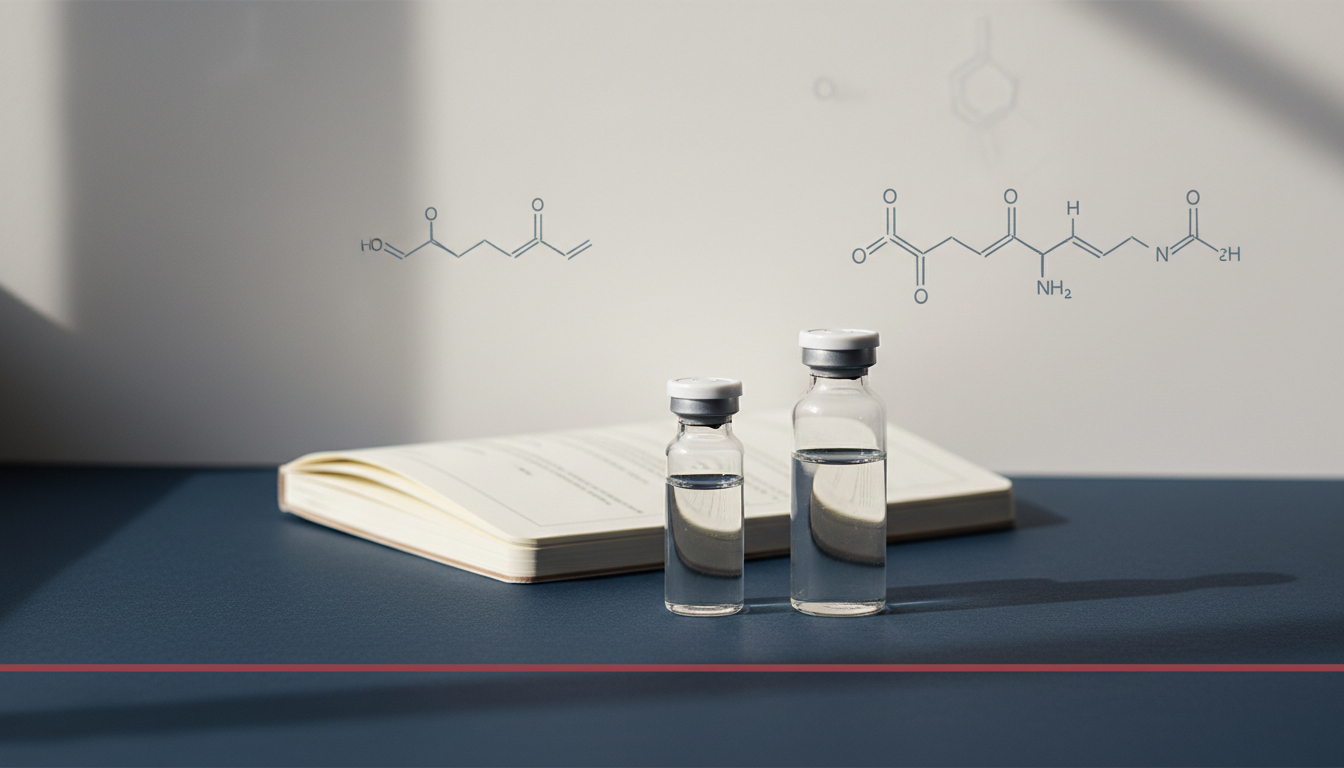
Side-by-side comparisons on PepVise rank by weight of evidence, not by bodybuilding forum consensus. Tier badges on every entry.
How we read the literature
- Evidence tier
- We grade the literature on four tiers, High (replicated RCTs or meta-analyses), Moderate (multiple trials with mixed findings), Low (a single pilot or case series), and Anecdotal (preclinical only, no human data). The tier appears on every compound profile beside the claim it supports.
- Trial stage
- Where a compound sits in the human development pipeline is recorded as Preclinical, Phase 1, Phase 2, or Phase 3+. We pull the current stage from ClinicalTrials.gov and the EU Clinical Trials Register on access date and re-verify quarterly.
- Regulatory status
- We state the FDA posture plainly, approved for indication X, or labeled for research use only, or removed from the 503A list, or investigational under a specific IND. Regulatory status changes; every post carries a review date.
- Where we're uncertain
- Every compound profile closes with a named uncertainty section, the question we can't answer from the current literature, the trial we'd want to see, the effect size we'd treat as a real signal. Uncertainty is not a failure mode here; it's load-bearing.
What readers ask us next.
- Are TB-500 and thymosin beta-4 the same thing?
- Not reliably. Thymosin beta-4 is a specific 43-amino-acid human protein. TB-500 is a research-market name that is sometimes the full protein relabeled and more often a shorter synthetic fragment built around the actin-binding motif LKKTETQ. Because independent testing of these vials is scarce, you usually cannot confirm which one you have, so they should not be treated as interchangeable.
- Which one has real research behind it?
- The protein. The credible clinical and preclinical work, including a randomized Phase 2 dry-eye trial and animal studies on wound and cardiac repair, was done on thymosin beta-4. The grey-market product called TB-500 has no comparable human trial record of its own; its recovery and injury claims borrow from research on the protein rather than on the product being sold.
- Does the LKKTETQ fragment work as well as the full protein?
- That is unproven. LKKTETQ is the short actin-binding motif of thymosin beta-4, so a fragment containing it can bind actin, but the full protein also has angiogenic, anti-inflammatory, and cell-migration roles that a short peptide may not reproduce. No human evidence establishes that a fragment matches the intact protein, so the claim should be treated as a hypothesis, not a fact.
- Is either one FDA-approved?
- No. Thymosin beta-4 reached Phase 2 human trials but was never approved for any indication, and any product sold as TB-500 is a research-use-only chemical outside the pharmacy channel. Neither carries the identity, purity, and sterility assurances of an approved medicine.
- Are TB-500 and thymosin beta-4 banned in sport?
- Yes, both. The World Anti-Doping Agency prohibits thymosin beta-4 and TB-500 at all times under its S2 category for growth factors and peptide hormones. The ban applies regardless of which molecule the vial actually contained, so debating the identity offers an athlete no protection.
A new Phase 2 trial for any of the ranked compounds. A regulatory action changing FDA status. A published replication failure in an independent lab. Any of those would move entries on this list within a week, with a dated note on what changed.
References cited on this page.
PubMed, ClinicalTrials.gov, and FDA documents only. Secondary sources appear when needed to characterize public discourse, never as a source for a clinical claim.
- [01]Goldstein AL, Hannappel E, Kleinman HK. Thymosin beta4: actin-sequestering protein moonlights to repair injured tissues. Trends Mol Med 2005
- [02]Crockford D et al. Thymosin beta4: structure, function, and biological properties supporting current and future clinical applications. Ann N Y Acad Sci 2010
- [03]Sosne G et al. Thymosin beta 4 ophthalmic solution for dry eye: a randomized, placebo-controlled, Phase II clinical trial. Clin Ophthalmol 2015
- [04]Malinda KM et al. Thymosin beta4 accelerates wound healing. J Invest Dermatol 1999
- [05]Bock-Marquette I et al. Thymosin beta4 activates integrin-linked kinase and promotes cardiac cell migration, survival and cardiac repair. Nature 2004
About The Pepvise Editorial Team
The Pepvise Editorial Team is a small group of researchers and science writers reading the peer-reviewed peptide literature and translating it into calm, cited analysis. We do not sell peptides, recommend peptides, or tell readers what to administer. We describe what has been measured, by whom, at what scale, with what effect size.
Compound reviews are signed off by Dr. Priya Narang, MD, MPH (endocrinologist) and Dr. Marcus Haley, PharmD, BCPS (board-certified clinical pharmacist). Both hold verifiable state-board licenses and have signed editorial-independence letters with us. See the full editorial board →
Adjacent in the literature.
BPC-157, What the Evidence Shows
Evidence Ledger for BPC-157: 50+ preclinical studies, 1 human pilot (Chang 2014, n=12), 1 active Phase trial, FDA removed from 503A list in 2023.
16 min readCompounds · Compound profileTB-500, The Field Guide
TB-500 vs Thymosin Beta-4 (same compound), mechanism, the preclinical tendon and recovery literature, and where the human data is thin.
14 min readCompounds · Compound profileGHK-Cu, Evidence and Hype
Copper peptide signaling, the topical RCT evidence for hair and skin, and the gap between topical and injectable claims.
13 min readGet the 2026 Peptide Evidence Ledger.
A 12-page PDF summary of where 10 major compounds sit, Preclinical / Human pilot / Phase trial / FDA status. Updated quarterly. Free.
By subscribing, you agree to our Privacy Policy. One calm, cited email a week. Unsubscribe anytime.